
Table of contents
- What an Amazon ads agency actually does
- Why ROI depends on more than lowering ACoS
- How Amazon PPC works at the campaign level
- The ROI advantages of specialized management
- Metrics that separate growth from noise
- Auditing your PPC before hiring
- The agency services that matter most
- Technology and automation
- Choosing the right agency
- Comparing agency models
- Contract terms that protect ROI
- Red flags to watch for
- Building a productive partnership
- Realistic expectations
- From ads to a growth system
- A practical ROI framework
- The takeaway
- FAQ
Amazon advertising can be a growth engine, but only when campaigns are built around profit, search visibility, and disciplined optimization instead of ad spend alone. A strong amazon ads agency helps brands turn Sponsored Products, Sponsored Brands, DSP, and related retail media activity into a measurable system for acquiring customers and supporting organic sales. This article explains how agency-led strategy can improve ROI, what metrics matter, and how to evaluate the right partner before you commit budget.
What does an Amazon ads agency actually do?
An amazon ads agency plans, builds, manages, measures, and improves paid advertising campaigns across Amazon’s ad ecosystem. At a basic level, that includes keyword research , campaign setup, bid adjustments , budget allocation, search term mining , negative keyword management , creative testing, and reporting. At a more strategic level, the agency connects advertising decisions to catalog health, organic ranking, inventory, pricing, seasonality, and total marketplace profitability.
That distinction matters. Many brands think of Amazon PPC as a set of buttons inside Campaign Manager: raise a bid, lower a bid, pause a keyword, increase a budget. Those tasks are important, but they are not the whole job. A good agency understands how a bid change might affect ad placement, conversion rate, rank momentum, margin, and inventory velocity.
The best agency relationships are not just about outsourcing clicks. They are about creating a repeatable growth system. For one brand, that may mean launching new ASINs with carefully controlled spend. For another, it may mean restructuring a cluttered account that has hundreds of campaigns but no clear strategy. For a larger catalog, it may involve combining amazon ppc management with listing optimization , brand defense, DSP retargeting, and cross-channel media planning.
Why ROI depends on more than lowering ACoS
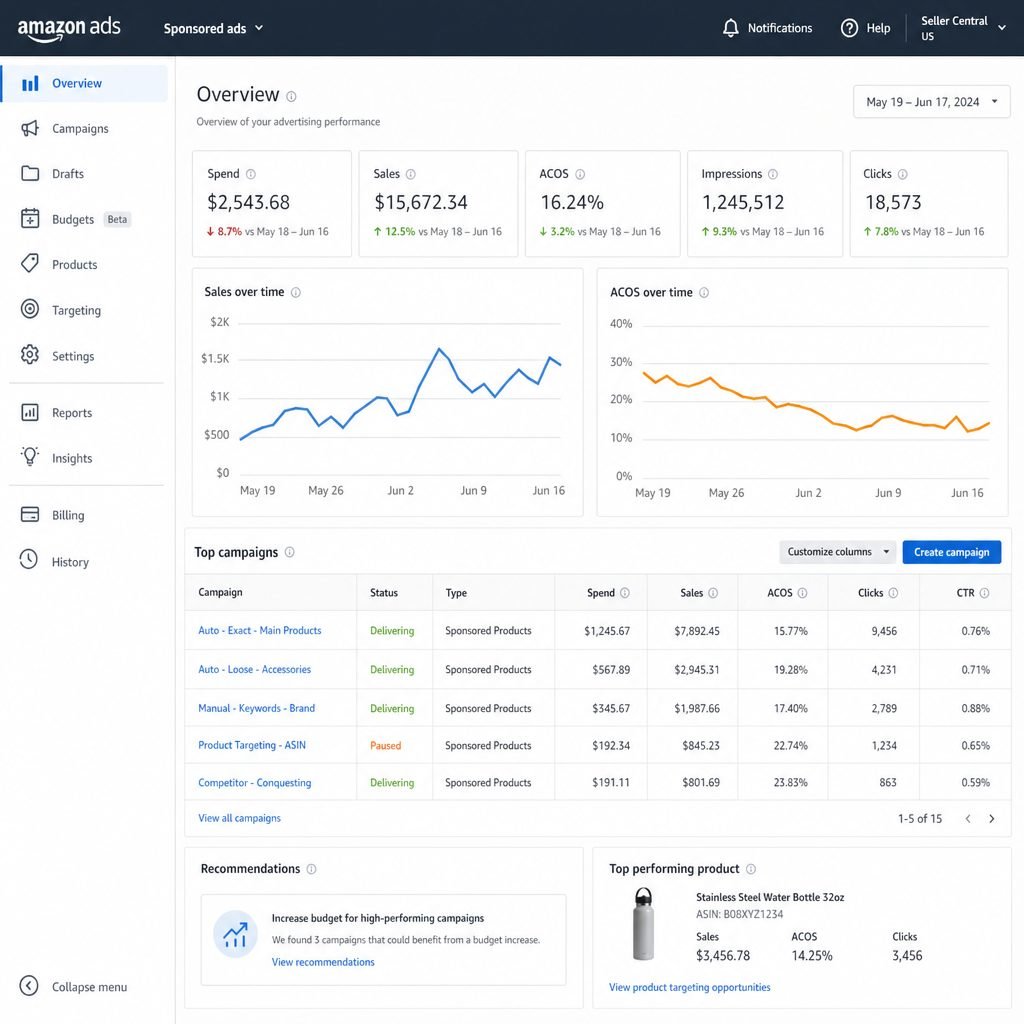
ACoS , or advertising cost of sales, is one of the most familiar Amazon advertising metrics. It tells you how much you spent on ads compared with the sales attributed to those ads. If you spend $25 to generate $100 in attributed ad sales, your ACoS is 25%.
That is useful, but it can also be misleading. A campaign can show an attractive ACoS while the brand’s total sales remain flat or decline. This happens when ads simply capture sales the product would have received organically, or when branded campaigns look efficient while non-branded discovery campaigns are underfunded. It can also happen when a brand cuts spend too aggressively, causing organic visibility to weaken over time.
That is why many sophisticated advertisers look at TACoS , or total advertising cost of sales. TACoS compares ad spend with total revenue, including organic sales. It helps answer a bigger question: is advertising helping the whole business grow more efficiently?
A good amazon marketing agency will usually watch both ACoS and TACoS. ACoS helps diagnose campaign-level efficiency. TACoS helps evaluate whether advertising is supporting overall account health. If ACoS improves but TACoS worsens, the brand may be losing organic strength. If TACoS improves while revenue grows, the advertising strategy may be creating healthier momentum.
ACoS and TACoS in plain English
Think of ACoS as a microscope and TACoS as a wide-angle lens. ACoS lets you inspect the performance of a campaign, keyword, or product target. TACoS lets you see whether paid media is improving or weakening the broader business.
A mature Amazon PPC strategy uses both. It does not treat every campaign the same, because not every campaign has the same purpose. A branded defense campaign may be expected to run at a low ACoS. A launch campaign for a new product may tolerate a higher ACoS for a limited period if it helps build visibility, reviews, and sales velocity. A non-branded ranking campaign may look expensive at first but still be valuable if it contributes to organic placement over time.
The key is to define the role of each campaign before judging it. If every campaign is measured only by short-term ACoS, brands often underinvest in discovery and overinvest in easy wins. If every campaign is allowed to spend freely in the name of growth, profitability suffers. ROI comes from balancing these forces with clear targets.
How Amazon PPC works at the campaign level
Amazon PPC is auction-based advertising. Advertisers bid for placements tied to shopper searches, product pages, and audience signals. When a shopper searches or views relevant content, Amazon evaluates eligible ads based on bid, relevance, expected performance, and other auction factors. The winning ad may appear in search results, on product detail pages, or in brand-focused placements depending on the ad type.
This means Amazon advertising is not only a bidding game. Relevance and conversion potential matter. A high bid cannot fully compensate for a weak product detail page, poor offer, low review count, unclear images, or misaligned keyword targeting. Likewise, a well-optimized listing can make ad spend work harder because more clicks turn into orders.
That is why agencies often begin with both media and retail readiness. Before scaling spend, they may review titles, images, bullet points, A+ content, pricing, promotions, inventory, and variation structure. If a product cannot convert traffic profitably, simply buying more traffic will not solve the problem.
The role of campaign architecture
Campaign architecture is the way an account is organized. It determines how budgets are assigned, how search terms are harvested, how bids are controlled, and how cleanly performance can be analyzed. Poor structure creates confusion. Good structure creates leverage.
A simple account may start with automatic campaigns, manual keyword campaigns, product targeting campaigns, and brand campaigns. As the account matures, each of those can be split by match type, funnel stage, product group, margin profile, or strategic goal. Some agencies use very granular structures, sometimes separating campaigns by ASIN, match type, and ad type so every budget and bid has a clear purpose.
Granularity can improve ROI because it gives the manager more precise control. If a broad match keyword is discovering useful search terms but also wasting spend, the agency can lower bids, add negatives, and move converting terms into exact match campaigns. If one ASIN has a better margin than another, budgets can reflect that reality. If a category is seasonal, bids can be adjusted before demand spikes instead of after the opportunity passes.
The goal is not complexity for its own sake. The goal is clean decision-making. When campaign structure is messy, agencies may not know which product, keyword, match type, or targeting logic is truly driving results. When structure is intentional, optimization becomes faster and more reliable.
The ROI advantages of specialized amazon ppc management
In-house teams can manage Amazon ads effectively, especially when they have enough time, experience, and data discipline. The challenge is that Amazon PPC can become increasingly complex as a brand scales. More ASINs, more keywords, more competitors, more ad types, and more reporting needs all create more decisions.
Specialized amazon ppc management can create value by bringing process and pattern recognition. An experienced team has usually seen many account structures, launch scenarios, ranking challenges, and budget constraints. That experience can shorten the learning curve and reduce avoidable mistakes.
An agency can also provide consistency. Amazon campaigns need frequent attention. Search terms change, bids drift, competitors adjust, inventory fluctuates, and budgets run out. A weekly review may be enough for a small account, but larger or more competitive accounts often benefit from a more active cadence. Daily or near-daily checks can catch wasted spend, capitalize on converting terms, and prevent budget issues from quietly damaging performance.
Key areas where specialized management often helps include:
- Keyword and search term discipline: Agencies can separate research, testing, scaling, and pruning so the account does not become cluttered with weak targets.
- Bid strategy: Experienced managers adjust bids based on placement , conversion rate, margin, inventory, and campaign purpose, not just surface-level ACoS.
- Budget allocation : Agencies can shift spend toward campaigns that support the strongest business goals, whether that is profitability, launch velocity, or brand defense.
- Catalog segmentation: Products with different margins, review profiles, prices, and life cycle stages should not all be managed under one generic strategy.
- Reporting clarity: Good agencies explain what changed, why it changed, and what the expected business impact should be.
- Testing structure: Creative, targeting, bids, coupons, and landing experiences can be tested in a controlled way instead of through random changes.
The most important benefit is not that an agency touches more buttons. It is that the agency should know which buttons matter, when to touch them, and how to interpret the outcome.
Metrics that separate growth from noise
Amazon advertising reports can produce a lot of data. Without a framework, teams may chase the wrong signals. A campaign with high sales may be unprofitable. A campaign with low ACoS may be doing little to grow the brand. A keyword with few orders may still be valuable if it reveals future demand or supports ranking for a strategic term.
A strong amazon ads agency should help the brand define a measurement hierarchy. Not every metric deserves equal attention. Some metrics are diagnostic, some are strategic, and some are guardrails.
Core PPC metrics to monitor
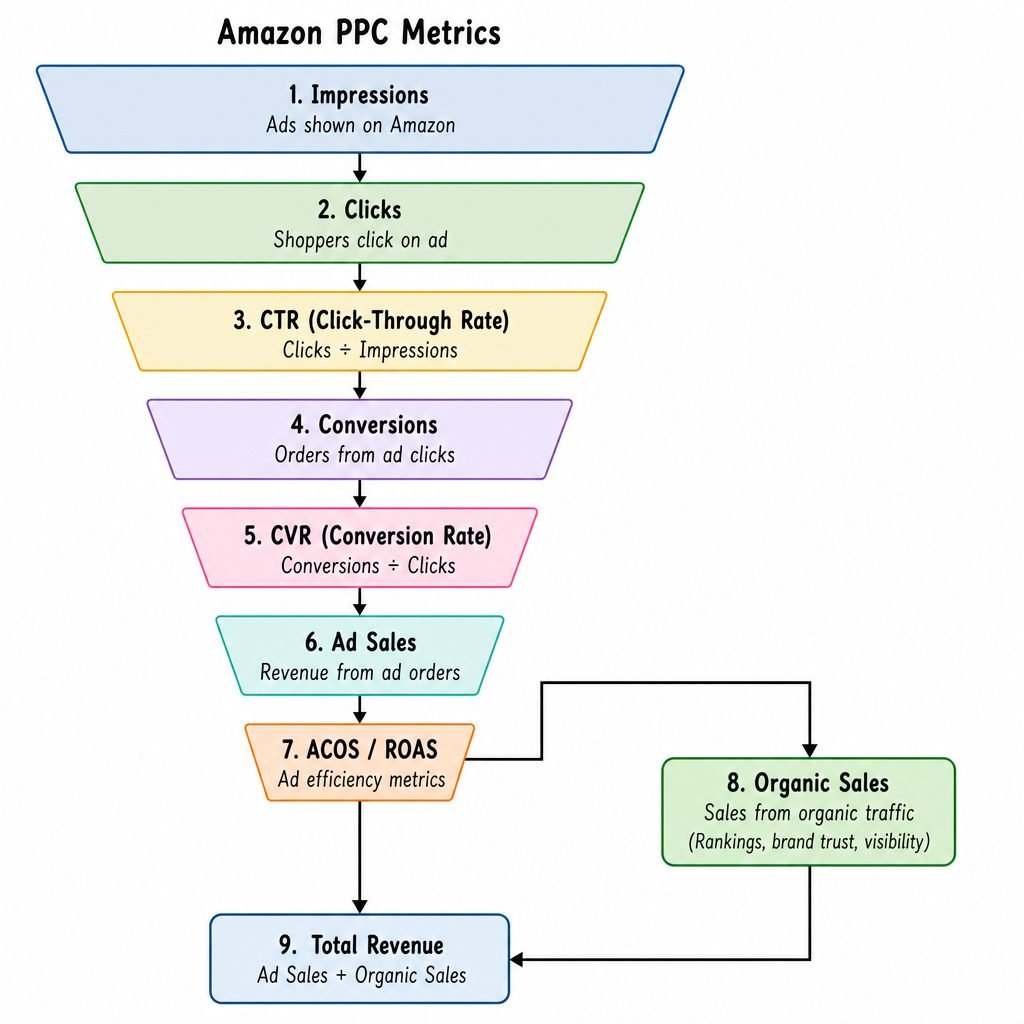
At the campaign level, these metrics help identify what is happening:
- Impressions: Shows whether ads are getting exposure. Low impressions may signal low bids, limited budget, weak relevance, or narrow targeting.
- Click-through rate: Indicates how often shoppers choose the ad after seeing it. Weak CTR may point to poor main images, pricing, reviews, title relevance, or placement mismatch.
- Cost per click: Helps explain spend efficiency and competitive pressure. Rising CPCs may require better conversion, tighter targeting, or revised bidding.
- Conversion rate: Shows whether traffic is turning into orders. Low conversion may be a listing, offer, review, or audience-quality problem.
- Attributed sales: Shows revenue linked to ads, but should not be viewed in isolation.
- ACoS and ROAS: Show ad-level efficiency, useful for campaign and keyword decisions.
- TACoS: Shows the relationship between advertising spend and total revenue.
These numbers should be interpreted together. For example, a campaign with strong CTR and weak conversion may attract attention but disappoint shoppers after the click. A campaign with low CTR and high conversion may be too narrow, underexposed, or limited by creative. A campaign with rising ACoS may still be acceptable if it is supporting a launch, but only if the brand has defined that strategy in advance.
Business metrics that PPC affects
Advertising also affects broader marketplace performance. Agencies should understand how PPC connects to:
- Organic keyword rank
- Total revenue and contribution margin
- Buy Box stability
- Inventory sell-through
- New-to-brand customer acquisition where available
- Subscribe & Save or repeat purchase potential
- Category share and competitive defense
- Review generation velocity, where sales volume contributes indirectly
These metrics help prevent narrow thinking. An ad campaign is not successful just because Campaign Manager looks good. It is successful when it supports the commercial reality of the business.
How should a brand audit Amazon PPC before hiring an agency?
A brand should audit its current Amazon PPC by looking at structure, spend distribution, search term quality, profitability, and reporting gaps before deciding what kind of agency support it needs. The goal is not to perform a perfect technical review. The goal is to understand whether the current account is controlled, measurable, and aligned with business goals.
Start with the basics. Are campaigns clearly named? Can you tell which ASIN, match type, targeting method, and objective each campaign supports? If the answer is no, the account may be hard to optimize. Messy naming and mixed targeting often lead to wasted spend because no one can easily see what is working.
Next, review where the money is going. Many accounts overspend on broad or automatic campaigns without harvesting winners into exact match campaigns. Others overspend on branded terms and underinvest in non-branded growth. Some spread budgets evenly across products even though margins and inventory positions differ. An audit helps reveal whether spend is following strategy or habit.
A practical PPC audit might include these steps:
- Map campaigns to business goals. Label campaigns as launch, ranking, profitability, brand defense, competitor targeting, or remarketing.
- Segment performance by product. Look at ad spend, sales, ACoS, TACoS, and conversion by ASIN rather than only account-wide averages.
- Review search term reports. Identify converting terms to scale, irrelevant terms to negate, and expensive terms that need tighter control.
- Compare ad sales with total sales. Look for signs that paid sales are growing while total sales remain flat.
- Check budget leakage. Find campaigns that run out of budget too early or consume spend without enough strategic value.
- Evaluate listing readiness. Review whether the products receiving traffic have strong images, clear copy, competitive pricing, and adequate inventory.
- Assess reporting quality. Determine whether current reports explain decisions or merely display numbers.
Running your own pre-agency audit first? Score your account structure, spend distribution, and search term quality in minutes — free.
Run the free PPC auditPair it with the free PPC audit checklist to work through every step above before you talk to agencies.
This audit also helps when speaking with agencies. Instead of saying, “We need better ads,” the brand can ask more specific questions: “How would you restructure campaigns by ASIN?” “How do you handle search term migration?” “How do you set TACoS targets?” Specific questions lead to more useful answers.
The agency services that matter most
Not every amazon marketing agency offers the same depth of service. Some focus almost exclusively on PPC campaign management. Others offer full marketplace support, including SEO, content, storefront strategy, inventory coordination, retail media, external traffic, and brand protection. The right choice depends on the brand’s size, internal team, catalog complexity, and growth stage.
A small brand with a limited catalog may need a lean PPC partner that can build clean campaigns, control waste, and guide launches. A mid-market brand with dozens of SKUs may need deeper catalog segmentation, advanced reporting, and listing collaboration. An enterprise brand may need full-funnel planning across Sponsored Ads, DSP, Amazon Marketing Cloud analysis, retail media networks, and external channels.
Sponsored ads management
Sponsored Products, Sponsored Brands, and Sponsored Brands Video are often the foundation of Amazon advertising. These formats help brands appear in search results and product discovery paths. Agencies manage them through keyword targeting, product targeting, creative testing, bid optimization, and budget planning.
Sponsored Products are typically closest to purchase intent because they promote individual products within shopping results and product pages. Sponsored Brands can support awareness, brand store traffic, and multi-product discovery. Video placements can help explain value quickly, especially when a product needs demonstration or differentiation.
A skilled agency will not treat all sponsored ads the same. It will consider funnel stage, product maturity, keyword intent, creative quality, and landing destination. The agency should also know when to use campaigns for testing and when to use them for scaling.
DSP and full-funnel advertising
Amazon DSP can help brands reach audiences on and off Amazon using display and video placements. It is often more relevant for brands with enough budget, data, and strategic need to move beyond search-based PPC. DSP may support awareness, consideration, retargeting, and customer re-engagement.
DSP is not automatically better than Sponsored Products. It serves a different purpose. If a brand’s listings are not converting, DSP may send more people into a weak experience. If the brand has strong retail fundamentals and a clear audience strategy, DSP can extend reach and support full-funnel growth.
An agency that manages DSP should be able to explain audience logic, frequency management, creative strategy, and how success will be measured. It should also clarify how DSP performance connects to Amazon sales, branded search lift, new-to-brand activity, and total account growth.
Listing and retail readiness support
Advertising cannot carry a weak product detail page forever. If shoppers click but do not buy, the brand pays for the lesson. That is why many agencies include or collaborate on listing optimization.
Retail readiness can include keyword-rich titles, benefit-led bullets, strong image sequencing, comparison charts, A+ content, storefront improvements, and review strategy within Amazon’s rules. It can also include operational issues such as inventory planning and promotion timing. If an item frequently goes out of stock, advertising efficiency and organic rank can suffer. If pricing is uncompetitive, campaigns may need to work harder for every conversion.
This is where a broader amazon marketing agency can add value beyond bid management. It can help align traffic, content, and offer quality so paid media has a better chance of producing profitable growth.
Technology and automation should support strategy
AI tools, automation platforms, and bid management systems can make Amazon advertising more efficient. They can monitor performance, adjust bids, identify anomalies, suggest keywords, and reduce repetitive manual work. Some tools are positioned as AI agents that automate parts of PPC management while keeping advertisers in control.
These tools can be valuable, but they are not a substitute for strategy. Automation needs rules, goals, and context. If a system is told to reduce ACoS at all costs, it may cut spend from important discovery campaigns. If it optimizes only for attributed revenue, it may miss margin, inventory, or organic rank considerations.
The best agencies use technology to increase precision, not to avoid thinking. They combine automation with human judgment about catalog priorities, competitive dynamics, brand positioning, and profitability. When evaluating an agency, ask what technology it uses, but also ask how decisions are reviewed. A proprietary tool is only useful if it helps the team make better choices.
Helpful questions include:
- What tasks are automated, and what decisions are made by a strategist?
- How often are bids and budgets reviewed?
- Can the agency explain the logic behind automated recommendations?
- Does the system account for TACoS, inventory, margin, and campaign objective?
- Who owns the data and campaign history if the relationship ends?
Technology should make the work more transparent, not more mysterious. If automation becomes a black box, the brand may struggle to understand why performance changed.
How do you choose the right Amazon marketing agency?
Choose an Amazon marketing agency by matching its capabilities, reporting style, category experience, and operating cadence to your business goals. The right partner should be able to explain how it will manage spend, measure success, protect account health, and communicate decisions. It should also be transparent about what it can and cannot control.
Start by clarifying your own needs. A brand launching its first few products does not need the same partner as a mature catalog with hundreds of ASINs. A brand focused on profit recovery needs different management than a brand preparing for aggressive category expansion. If you define the business objective first, agency evaluation becomes much easier.
Agency evaluation checklist
Use this checklist to compare potential partners:
- Amazon specialization: Does the agency focus deeply on Amazon, or is Amazon a small add-on to broader digital services?
- Campaign structure approach: Can it explain how it organizes campaigns by ASIN, match type, objective, and funnel stage?
- Optimization cadence: How frequently does it review bids, budgets, search terms, and performance anomalies?
- Metric philosophy: Does it discuss TACoS, total sales, contribution margin, and organic growth, or only ACoS and ad revenue?
- Reporting transparency: Will reports show actions taken, insights learned, and next steps, not just dashboards?
- Case evidence: Can the agency share relevant examples with clear context, time frames, and constraints?
- Technology stack: Does it use tools that improve precision while still allowing human oversight?
- Retail readiness support: Can it advise on listings, creative, storefronts, promotions, and inventory implications?
- Communication model: Who will manage the account day to day, and how often will you speak with them?
- Data ownership: Will you retain access to campaigns, reports, historical data, and learnings?
- Compliance awareness: Does the agency understand Amazon policies and avoid risky tactics?
Pay close attention to how agencies answer. Strong partners explain trade-offs. Weak partners rely on vague promises. If an agency guarantees rapid results without understanding your catalog, margins, competition, and current account state, be cautious.
Questions to ask before signing
A good discovery call should feel like a strategic diagnosis, not a generic sales pitch. Ask questions that reveal how the agency thinks:
- How would you approach a campaign restructure without disrupting existing sales?
- How do you decide when to increase spend on a high-ACoS keyword?
- How do you separate branded, non-branded, competitor, and category campaigns?
- How do you use search term reports to refine targeting?
- What would you look at if ad sales increased but total sales stayed flat?
- How do you coordinate PPC with listing optimization and inventory availability?
- What does a normal weekly or monthly report include?
- What happens if performance declines after onboarding?
The best answers will be specific but not reckless. No agency can responsibly prescribe a full strategy without seeing the account. However, experienced teams can still explain their principles, diagnostic process, and decision framework.
Comparing agency models
Different brands need different types of support. The table below outlines common agency models and when they may fit.
| Agency model | Best fit | Strengths | Watchouts |
|---|---|---|---|
| PPC-only specialist | Brands that mainly need amazon ppc management | Deep campaign focus, efficient structure, frequent optimization | May not support content, inventory, or broader marketplace needs |
| Full-service Amazon agency | Brands needing ads, SEO, content, and account support | Stronger connection between traffic and retail readiness | Can be more expensive or broader than a small brand needs |
| Retail media agency | Larger brands advertising across Amazon and other marketplaces | Full-funnel planning, DSP, audience strategy, cross-channel insights | May require higher budgets and more internal coordination |
| Consultant or fractional expert | Brands wanting strategy, audits, or team training | Flexible, senior guidance, useful for in-house teams | Execution capacity may be limited |
| Software-led management | Brands comfortable with tools and internal oversight | Automation, reporting scale, potential efficiency | Strategy may be thin if not paired with expert judgment |
There is no universally best model. The right model is the one that solves your bottleneck. If your campaign structure is broken, a PPC specialist may be ideal. If your listings are weak, a full-service partner may create more value. If your internal team is capable but needs strategic direction, a consultant may be enough.
Contract terms can protect ROI
Agency selection is not only about strategy. The agreement itself can affect transparency, accountability, and long-term control. Before signing, brands should understand fees, ownership, access, communication expectations, and exit terms.
Some agencies charge a flat monthly retainer. Others charge a percentage of ad spend, a hybrid retainer plus spend percentage, or performance-based fees. The right structure depends on scope and incentives. A percentage-of-spend model can scale with workload, but brands should ensure it does not encourage unnecessary spend. A flat retainer can be predictable, but it should reflect the level of management required.
Avoid judging fees in isolation. A low-cost provider that wastes budget can be more expensive than a higher-cost partner that improves profitability. At the same time, a premium agency should be able to justify its scope, process, and senior involvement.
Before signing, clarify:
- Who owns the advertising account and campaign history
- What access the agency needs and what permissions it receives
- Whether reports and raw data remain available after termination
- How often meetings occur and who attends them
- What deliverables are included each month
- How strategy changes are approved
- Whether creative, copy, or listing work is included
- What notice period is required to end the agreement
- How the agency handles compliance concerns
Data ownership is especially important. A brand should not lose access to campaign learnings if it changes partners. Historical search term data, campaign structure, and performance trends are valuable assets. Make sure the agreement protects them.
Red flags that deserve caution
Most agencies present themselves as experienced, data-driven, and performance-focused. The challenge is identifying which ones can actually deliver thoughtful management. Red flags often appear in the sales process before the contract is signed.
Be cautious if an agency offers a one-size-fits-all strategy without reviewing your account. Amazon advertising depends heavily on category, price point, margin, review profile, inventory, and competitive pressure. A generic plan may not fit your reality.
Also be wary of reporting that emphasizes vanity metrics. Impressions, clicks, and ad sales matter, but they do not automatically prove profitable growth. If the agency avoids discussing total sales, TACoS, margin, or organic ranking, its optimization may be too narrow.
Other warning signs include:
- Promising guaranteed rankings or unrealistic sales growth
- Refusing to explain campaign structure or optimization logic
- Reporting only once a month with little commentary
- Making large changes without approval or context
- Overusing broad match without strong negative keyword discipline
- Pushing spend increases before fixing conversion problems
- Ignoring inventory constraints or product profitability
- Using tactics that could put account health at risk
A good agency relationship should make you feel more informed, not less. You do not need to manage every detail, but you should understand the strategy and the reason behind major decisions.
Building a productive agency partnership
Hiring an amazon ads agency does not mean the brand becomes passive. The best results usually come from collaboration. The agency brings media expertise, marketplace experience, and optimization discipline. The brand brings product knowledge, margin context, inventory visibility, customer insight, and business priorities.
That collaboration should begin during onboarding. Share product margins, hero ASINs, launch plans, promotional calendars, inventory concerns, seasonality, and previous campaign learnings. If certain products are more strategic than others, say so. If the brand can tolerate a higher ACoS during a launch period, define the limit and timeline.
Set expectations around communication. Decide which metrics will be reviewed weekly, which decisions require approval, and which actions the agency can take independently. A mature partnership has room for proactive optimization while still keeping the brand informed.
What to share with your agency
To help your agency make better decisions, provide:
- Product-level margins or margin tiers
- Inventory forecasts and restock timing
- Priority ASINs and products to avoid promoting
- Upcoming promotions, coupons, or seasonal pushes
- Brand positioning and key differentiators
- Customer objections or common questions
- Historical ad reports if available
- Organic keyword priorities
- Competitor names and category context
- Internal goals for revenue, profit, launch, or market share
This information helps prevent disconnected PPC decisions. For example, an agency may see strong campaign performance for a product, but if inventory is low, scaling spend could create stockout risk. Another product may show a higher ACoS but have strong repeat purchase behavior, changing how the brand evaluates acquisition cost.
Realistic expectations for performance improvement
Amazon PPC improvement rarely happens in a straight line. When an agency takes over, it may need to clean up structure, isolate data, test bids, add negatives, refine targeting, and improve listings. Some changes can produce quick wins, such as pausing irrelevant spend or fixing budget waste. Other gains take longer because they depend on learning cycles, ranking movement, creative testing, and marketplace response.
Brands should expect a diagnostic period. During this time, the agency may identify which campaigns are reliable, which are wasteful, and which need rebuilding. Performance can fluctuate if budgets are reallocated or campaigns are restructured. That does not necessarily mean the strategy is failing, but it should be explained clearly.
The agency should set expectations by objective. Profitability recovery may focus on waste reduction and tighter bids. Launch growth may require controlled investment and broader testing. Market share expansion may involve higher spend, more aggressive placements, and full-funnel support. Each objective has different risk, timeline, and measurement.
The strongest partnerships define success in stages:
- Stabilize: Fix obvious waste, naming issues, budget leakage, and tracking confusion.
- Clarify: Segment campaigns by purpose, product, match type, and performance profile.
- Optimize: Adjust bids, negatives, budgets, placements, and targeting based on clean data.
- Scale: Expand winning search terms, products, audiences, and creative once the economics make sense.
- Integrate: Connect PPC with content, inventory, promotions, DSP, and broader marketing.
This staged view keeps everyone grounded. It prevents panic when early restructuring creates noise and prevents overconfidence when one good week makes performance look solved.
Turning advertising into a marketplace growth system
The biggest shift in Amazon advertising is moving from campaign management to marketplace growth management. Ads do not operate in isolation. They interact with organic rank, listing quality, price competitiveness, reviews, inventory, and brand awareness. When those pieces work together, paid media becomes more efficient.
For example, a brand launching a new product may use Sponsored Products to gather search term data, Sponsored Brands Video to communicate differentiation, and listing optimization to improve conversion. As converting terms emerge, the agency can move them into more controlled campaigns. As organic visibility improves, the brand can monitor TACoS to see whether paid investment is supporting total growth.
A mature brand may use a different playbook. It might defend branded terms, target competitor ASINs, push high-margin products, use DSP for remarketing, and coordinate promotions around seasonal demand. The agency’s role is to make sure each tactic has a purpose and a measurement plan.
This is where an amazon marketing agency can be more valuable than a narrow media buyer. It can connect the dots between traffic, conversion, merchandising, and long-term account health. The result is not just better ads. It is better decision-making across the Amazon business.
A practical framework for maximizing ROI
Maximizing ROI with Amazon ads requires discipline. It is not about cutting every cost or spending aggressively on every opportunity. It is about matching investment to intent, product economics, and growth stage.
Use this framework to guide your strategy:
- Define the business goal first. Decide whether the priority is profit, launch velocity, organic rank, brand defense, or market expansion.
- Segment the catalog. Group products by margin, inventory, maturity, review strength, and strategic importance.
- Build clean campaign architecture. Separate targeting types and objectives so performance can be understood and controlled.
- Measure beyond ACoS. Use TACoS, total sales, conversion rate, and margin context to judge true impact.
- Optimize frequently. Review search terms, bids, budgets, and placement performance before small problems become expensive.
- Improve conversion. Strengthen images, copy, pricing, offers, and reviews so traffic has a better chance to convert.
- Scale only what proves itself. Increase investment where data, margins, and business goals support it.
- Keep learning visible. Document insights so each test makes the account smarter.
This framework is simple, but it is not always easy. It requires consistent execution and honest reporting. That is why many brands eventually seek agency support: not because Amazon advertising is impossible to manage internally, but because the cost of unfocused management can be high.
The takeaway
An amazon ads agency can help brands maximize ROI by bringing structure, measurement discipline, optimization cadence, and marketplace context to Amazon advertising. The right partner will look beyond surface-level ACoS and focus on the relationship between paid spend, total revenue, profitability, and organic growth.
Before hiring an agency, audit your current account, clarify your goals, and ask detailed questions about campaign structure, TACoS reporting, technology, data ownership, and communication. The best agency is not simply the one that promises more sales. It is the one that can explain how advertising will support a healthier Amazon business.
When PPC, listings, inventory, and strategy work together, Amazon advertising becomes more than a cost center. It becomes a controlled growth lever—one that can help the right products reach the right shoppers at the right time, with a clearer path to sustainable return.
Related reading
- Best Amazon Ads Agency Guide for Brands (2026)
- Amazon PPC Audit Service: What a Real Audit Covers
- Amazon PPC Campaign Structure That Scales
- What Is a Good ACoS on Amazon?
- What Is a Good TACoS on Amazon?
- Amazon PPC Budget: How Much Should You Spend?
Amazon ads agency FAQ
An amazon ads agency plans, builds, manages, measures, and improves paid advertising campaigns across Amazon’s ad ecosystem — covering keyword research, campaign setup, bid adjustments, budget allocation, search term mining, negative keyword management, creative testing, and reporting. Strategically, it connects advertising decisions to catalog health, organic ranking, inventory, pricing, seasonality, and total marketplace profitability.
ACoS only compares ad spend with attributed ad sales, so it can look attractive while total sales stay flat — for example when ads capture sales the product would have earned organically, or when efficient branded campaigns mask underfunded non-branded discovery. TACoS compares ad spend with total revenue including organic sales, showing whether advertising is helping the whole business grow more efficiently.
Review campaign structure and naming, where spend is going, search term quality, profitability by ASIN, and reporting gaps. Map campaigns to business goals, segment performance by product, mine search term reports for winners to scale and waste to negate, compare ad sales with total sales, check budget leakage, evaluate listing readiness, and assess whether current reports explain decisions or merely display numbers.
Be cautious of one-size-fits-all strategies offered without reviewing your account, reporting that emphasizes vanity metrics while avoiding total sales, TACoS, margin, or organic ranking, guaranteed rankings or unrealistic sales growth, refusal to explain campaign structure or optimization logic, and tactics that could put account health at risk.
Expect a diagnostic period first: stabilizing waste, clarifying campaign structure, then optimizing bids, negatives, budgets, and targeting before scaling what proves itself. Quick wins like pausing irrelevant spend can land fast, but gains tied to learning cycles, ranking movement, and creative testing take longer — define success in stages so early restructuring noise isn’t mistaken for failure.
Want agency-level PPC discipline without the agency retainer?
BidPilot applies the same fundamentals in this guide — clean campaign structure, search term mining, bid optimization, and TACoS-aware reporting — automatically, every day.
30 days free · No credit card · Cancel anytime